


Find all the practical info you need to plan your cycling adventure in Isère.
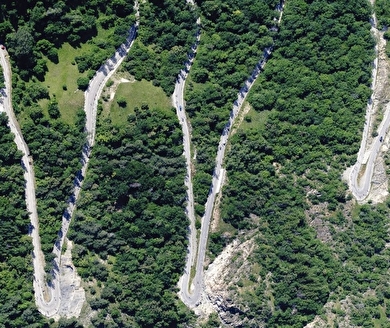
The 21 bends of Alpe d'Huez: a stroke of genius
The world’s greatest cycling race will be whizzing through Isère for three different stages this summer. The region will host stages 18, 19 and 20 in Voiron, Alpe d’Huez and Bourg-d’Oisans.
On the edge of the Isère region, the legendary 21 bends of Alpe d’Huez draw cyclists and lovers of dramatic landscapes, symboling a shared passion for cycling felt around the world.
This is a look back at the fascinating history of these numbered hairpin bends, conceived in 1964 by visionary hotelier Georges Rajon and, over successive editions of the Tour de France, transformed into one of the most legendary and feared challenges in professional cycling.
Although the resort of Oisans is world-famous in both summer and winter, it owes this in part to a visionary hotelier, Georges Rajon.
He was the man who conceived the idea of numbering the 21 bends, helping cement the Tour de France’s media success — and the same man who took on the challenge of creating the Sarenne, the longest ski run in Europe, and the Tunnel run, both in Alpe d’Huez.
An idea born on a trip to Slovenia
It all began in 1964, when Georges Rajon travelled to Slovenia. A businessman and keen sportsman, he discovered the 50 numbered hairpin bends winding up and over the Vrsic Pass `- and was immediately struck by an idea: what if he did the same on the road to Alpe d’Huez?
Back in Oisans, he had numbered signs installed at each of the 21 bends along the 14-kilometre climb between Bourg-d’Oisans and the resort – but in descending order, like a breathless countdown to the summit. This seemingly insignificant detail would go on to transform a mountain road into one of the most legendary events in world sport.

The idea struck me straight away: what if we did the same on the road to Alpe d’Huez?
1952: the Tour de France discovers Alpe d’Huez
Even before the introduction of stage numbers, Georges Rajon had played a key role in the history of the Tour.
In 1952, while serving as president of the resort’s sports club, he helped bring a stage of the Tour de France to the high-altitude resort of Alpe d’Huez for the very first time.
On that day, the Italian Fausto Coppi left the competition in his wake and crossed the finish line alone at the summit, in a display of strength that has remained etched in the memory.
Yet, despite the champion’s remarkable feat, the enthusiasm did not last. The Tour de France would not return to these slopes for another 24 years.

1976: the birth of a legend
It wasn’t until 1976 that the Tour de France returned to Alpe d’Huez. Once again, Georges Rajon led the charge.
At the request of his friend Georges Lachat, a journalist at Le Dauphiné Libéré, he and a group of local hoteliers dug deep into their pockets to fund the race’s passage through the area – to the tune of 100,000 new francs, equivalent to around €46,000 today.
It proved a winning bet. Dutchman Joop Zoetemelk took victory at the summit, and his cycling-mad compatriots flooded the mountain in their thousands.
For eight consecutive years, Dutch riders would go on to triumph at Alpe d’Huez, turning the 21 bends – and particularly bend number 7 – into a wall of orangel, swamped by thousands of ecstatic supporters.

The 21 bends: the world’s cycling mecca
Images of fans from all over the world storming these famous corners have spread across the globe.
All the great names in cycling have left their mark here: Hinault, Fignon, Pantani, Armstrong, Contador, Froome, Vingegaard.
Alpe d’Huez is now regarded as the quintessential mountain stage of the Tour de France. Having featured in 30 editions of the race, it has never lost its magic. Every summer day, more than 300 cyclists of all backgrounds make the pilgrimage to conquer the 21 bends, following in the tyre tracks of champions.
Each numbered hairpin has become a landmark: a symbol, a piece of living cycling history.
Whether you’re a seasoned cyclist or simply a lover of great stories, tackling the 21 bends of Alpe d’Huez is much more than a sporting feat – it’s a journey through the living history of cycling.