


Château de Fallavier

Built on the part west of the hill Relong (344m), the Castel testifies of than 1000 years of history. This strategic position was taking advantage during the war between the Savoie and the Dauphiné (1250-1555).
Fallavier, a castle at the heart of regional history, dominating the plain of the Lower Dauphiné!
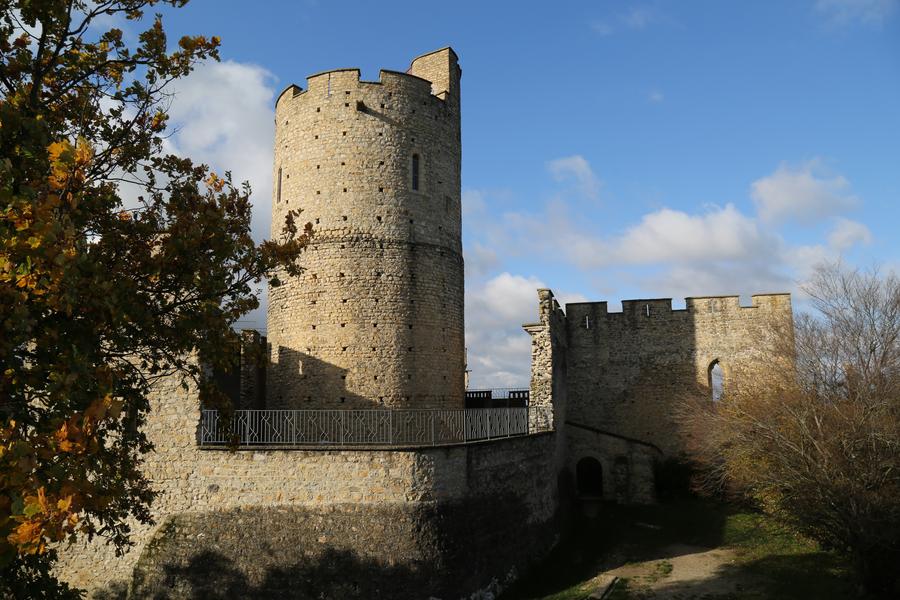
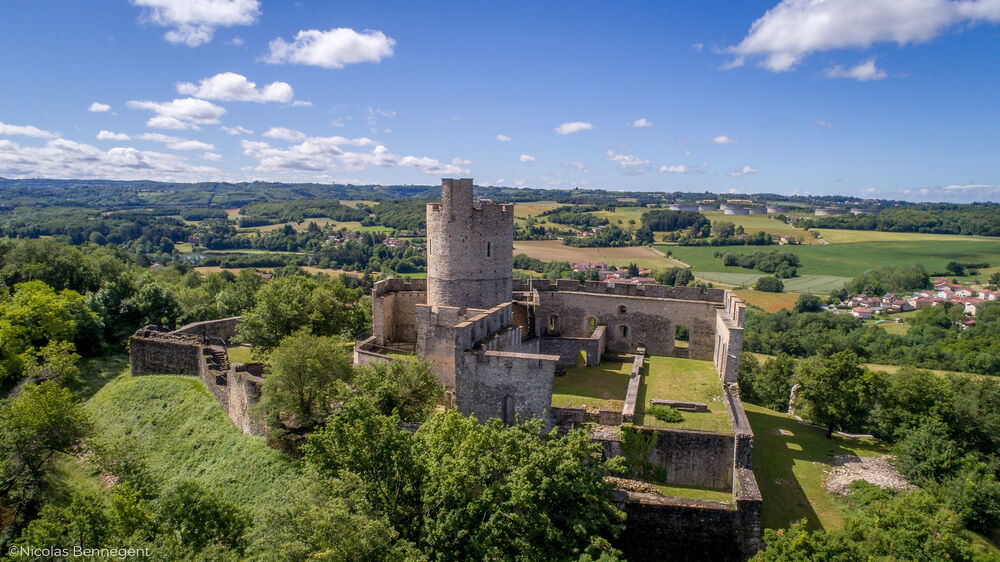
Perched at the western end of the Relong hill, separated from the rest of the hill by a wide moat, the site of the ancient castle (and town) of Fallavier today comprises a powerful circular keep, around which are organized the castral buildings (large hall called "aula", chapel, bedrooms, kitchen and stables) surrounded by a first enclosing wall forming a chemise and delimiting a high courtyard.
The second wall once housed a dense group of residential buildings and, on the slope, the former village, now completely destroyed. Still in ruins at the beginning of the 20th century, the building was extensively restored (all the upper parts of the enclosure walls and keep were rebuilt) in the 1970s by its former owner.
History: Although the existence of an earlier fortification is not known, mention of a "mandement" at Fallavier is attested to as early as 1175 in the cartulary of the Abbey of Note-Dame de Bonnevaux. The history of the château is better known today, and is linked to the financial difficulties of the de Beauvoir family and the rivalries between the lords of La Tour, the future dauphins, and the House of Savoy. The architectural features of the original part of the keep point to the end of the 13th century as the date of construction, which is confirmed by archives attesting to extensive work carried out in 1280 by the mason Tassin de Saint-Georges for the House of Savoy.
The châtellenie remained Savoyard until 1355, when the Treaty of Paris established the borders with Savoy. It was then entrusted by Charles V to the Count of Geneva after 1369, and returned to the Delphinian domain in 1391.
In 1593, the lands of Fallavier were sold to François de Bonne, Seigneur de Lesdiguières, thus leaving the royal domain for good.
The Rolland family acquired the ruins of the building in 1891. One of their descendants, Gabriel Mérard, surrounded himself with volunteers and, from 1969 onwards, devoted himself to the reconstruction and rebirth of this edifice. Since 1992, the commune of Saint-Quentin-Fallavier has owned the château and is responsible for its conservation and enhancement.
Good to know
Unguided outdoor visits all year round.
Schools and groups welcome all year round by appointment.
Practical information
Equipments
-
Coach parking,
-
Parking nearby,
-
Car park,
-
Picnic area,
-
Orientation board,
-
Toilets
Services
-
Pets welcome,
-
Educational visits,
-
Coach access,
-
Booking obligatory,
-
Set down on-site for groups,
-
Guided tours
Activities
-
Concert,
-
Shows,
-
Children's entertainment
Theme
-
Fortified castle,
-
Keep,
-
Historic patrimony
Time schedule
From 03/01/26 to 10/25/26
-
Monday :
Closed
-
Tuesday :
Closed
-
Wednesday :
Closed
-
Thursday :
Closed
-
Friday :
Closed
-
Saturday :
Closed
-
Sunday :
14h30 to 18h30
-
Jours fériés :
Closed
Prices
Payment method
-
Check,
-
Cash,
-
Credit transfer
Free of charge. Free admission for individual visitors on Saturdays, Sundays and public holidays from March to October. Open on other days of the week for group tours, by appointment. Quotation on request.
Download documents
Tips
Unguided outdoor visits all year round.
Schools and groups welcome all year round by appointment.
See more
-
Espace naturel sensible de l'étang de Fallavier et Vallon du Layet
Place: Saint-Quentin-Fallavier
-
Parc de Fallavier
Place: Saint-Quentin-Fallavier

-
Randonnée pédestre découverte de Saint-Quentin-Fallavier
Place: Saint-Quentin-Fallavier
Elevation 109m

-
Randonnée VTT découverte de Saint-Quentin-Fallavier
Place: Saint-Quentin-Fallavier
Elevation 109m
Go there
Latitude : 45.628902
Longitude : 5.122268
Height : 308
38070 Saint-Quentin-Fallavier
Go there
From Grenoble, take the A43 freeway in the direction of Lyon, at the St Quentin Fallavie toll barrier, take exit 5, direction Vienne on the D75, then the D311 to St Quentin-Fallavier.
Accessible by public transport and by walking :
- From the La Verpillière or the train station St-Quentin Fallavier : bus 7 to the stop Les Gargues then 20 minutes on foot
- From the train station L'Isle d'Abeau : bus 6 to the stop Les Moines then 20 minutes on foot
Information updated on 31/07/2026
by Office de Tourisme CAPI - Porte de l'Isère