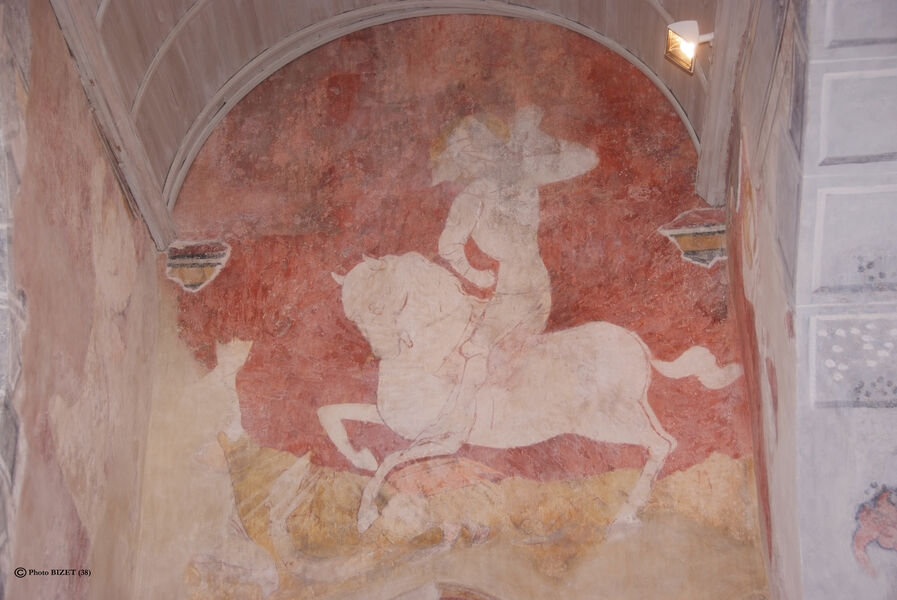



Augustinian paintings from the church choir

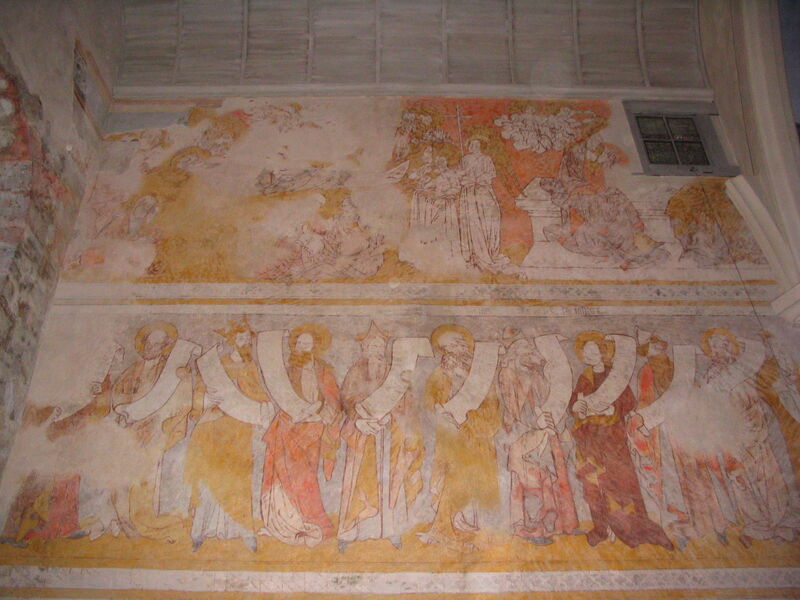
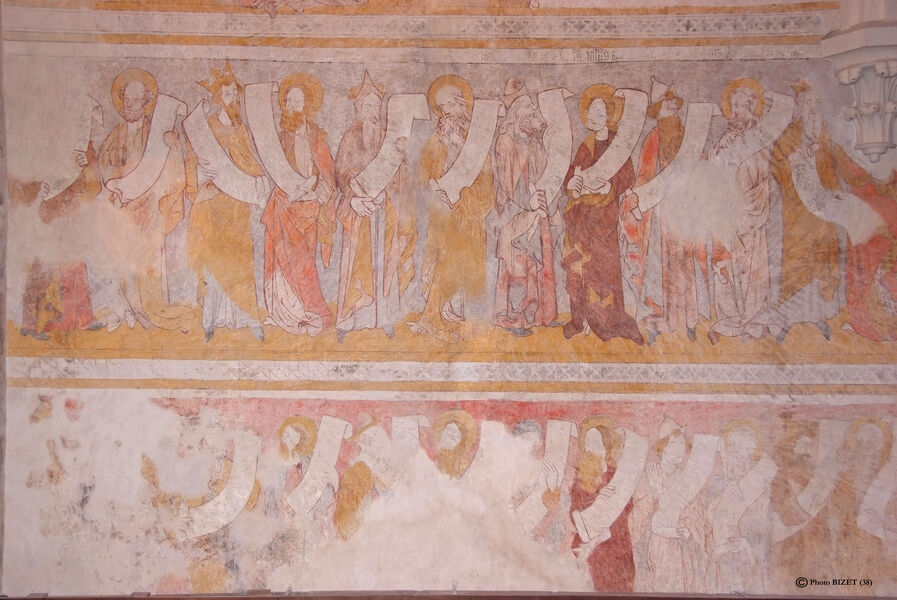
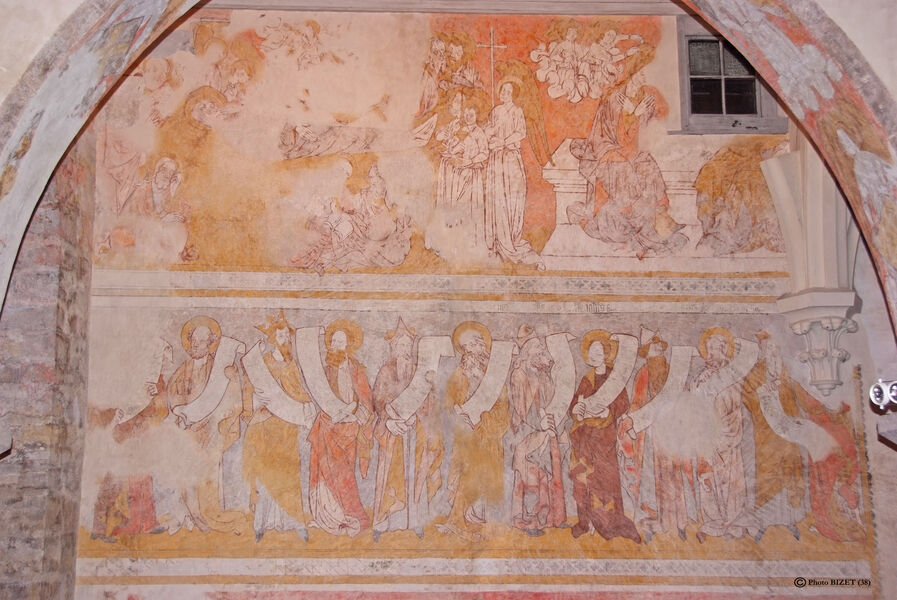
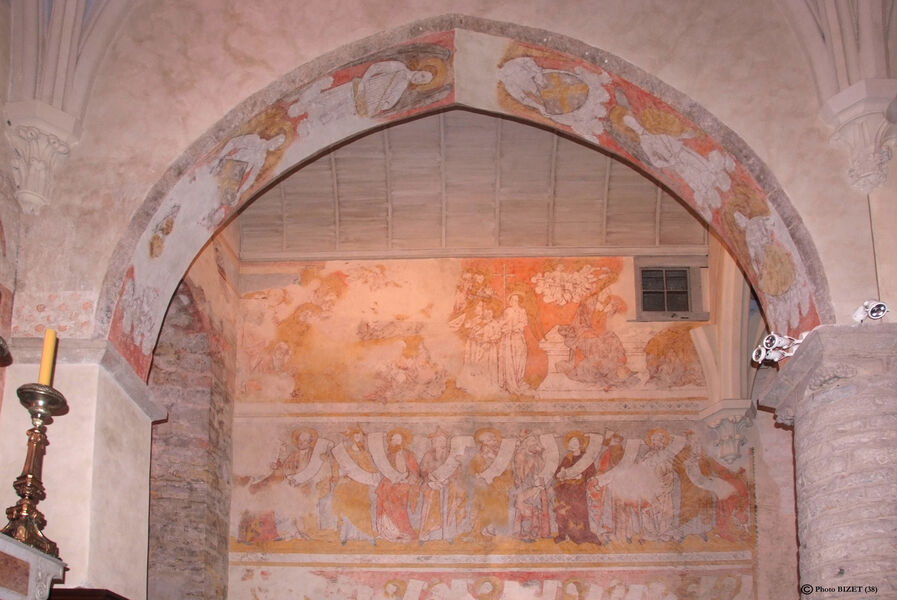
These paintings, released since the 2000s, constitute an important historical testimony. They are located in the choir and form a unique iconographic ensemble in Europe, including the Double Creed and the Dormition of the Virgin.
This church was the Eremite chapel of Saint Augustine from 1570 to 1647, when the monks served the parish. It became the church of Saint John the Baptist during the Revolution, when the municipality purchased all the monastic buildings.
The section of the church between the octagonal columns and the entrance dates from the 15th century, as do the six side chapels along the walls of the nave. Other features are 17th-century, including the chapel of the Vallin family, above which is the Rosary High Chapel, on the right before the chancel.
This church was built in the "market hall" layout which was favoured by the mendiant orders, with a rectangular shape and a nave with three aisles and a low radiating chapel. The original oak-panelled ceiling was replaced in the 19th century with a neo-Gothic rib vault design.
The pulpit standing at the centre and the stalls on either side are made of walnut wood and are the work of a carpenter from Crémieu named Grillat.
The organ above the main door was originally installed in the town's former parish church. Dating from 1785, it is the oldest church organ in the department of Isère.
Finally, to the right of the door, the model of the town as it looked in the Middle Ages is well worth seeing.
From the second half of the 14th century, the Augustinian Eremites had sufficient resources to decorate their chapel, and proceeded with a succession of 3 wall-painting campaigns.
These paintings, which were cleaned in the 2000s, are of great historical importance. We do not know who the painters were or where they came from and their work has not been dated.
However, a study has given us a little more insight into how the twenty or so identified scenes were produced. The painters coated the walls with primer before adding a finishing layer on which they used red ochre to sketch the initial outlines. They then used paints, made with natural and synthetic mineral pigments, to decorate the walls of the chancel and both side aisles.
Start by standing in the wing to the right of the chancel.
Look at the right-hand wall. The decor is split horizontally into three different themes that are typically present in the religious buildings of that period.
At the bottom-centre is a line of prophets and apostles, facing one another in pairs, and each carrying a kind of banderol known as a phylactery. Inspired by Saint Augustine's sermons, this theme forms the link between the Old and New Testaments.
The painting on the higher part of the wall depicts the life of the Virgin Mary.
On the wall which has a window you can see on either side two saints, a woman at the bottom and a man at the top. The female saint on the right is almost certainly Saint Monica, the mother of Saint Augustine. In the arch between the right-hand side aisle and the chancel are six angels playing instruments and bearing a family crest which suggests financial donations from a wealthy family.
Next, go to the chancel to see the wall paintings in the centre. Below the window on the right you'll see the Virgin and Child and, on the left, a scene of charity. A little further to the left, a count's crown decorates the top of a coat of arms, undoubtedly that of one of the patron families.
The other scenes feature traditional Christian illustrations, including the Glory of Christ and the crowning of the Virgin Mary.
Finally, walk down the left side-wing. The paintings above the window represent the Glory of Christ and, higher up, Saint George slaying the dragon. This parable about the victory of faith over evil was a very common theme from the 13th century onwards.
Practical information
Equipments
Parking nearby
Theme
-
Religious heritage,
-
Church
Time schedule
From 01/01/26 to 12/31/26
-
Monday :
Open
-
Tuesday :
Open
-
Wednesday :
Open
-
Thursday :
Open
-
Friday :
Open
-
Saturday :
Open
-
Sunday :
Open
-
Jours fériés :
Closed
Prices
Free
See more
-
The Crémieu Market Hall
Place: Crémieu

-
St. John the Baptist Church
Place: Crémieu

-
The Augustinian Cloister
Place: Crémieu

-
Porte de la Loi
Place: Crémieu

-
Porte de Quirieu
Place: Crémieu

-
The former Ursuline convent, now the Ursulines Brewery
Place: Crémieu

-
Pendulum Fountain
Place: Crémieu

-
Crémieu City Hall
Place: Crémieu

-
The Calefactory
Place: Crémieu

-
The Chapter House
Place: Crémieu

-
The new gate known as the ‘François I Gate’
Place: Crémieu

-
Augustins Street
Place: Crémieu

-
Place de la Nation
Place: Crémieu

-
The Colombier House
Place: Crémieu

-
The Visitandines' Apothecary
Place: Crémieu

-
The Old Tanners’ Street
Place: Crémieu

Go there
Latitude : 45.724806
Longitude : 5.250944
Height : 224
Place de l'Eglise
38460 Crémieu
Go there
Information updated on 07/08/2026
by Office du Tourisme Les Balcons du Dauphiné